
Start with the day's numbers
List everything that charges in the field: drone batteries, tricycle batteries, tools, lights and pumps. For each item, estimate how many charges per day and how much energy each charge takes. The sum is the day's energy in kWh. Then look at which chargers run at the same time: that sum, in kW, is the peak power the source must deliver. As an illustrative example, two 8 kW chargers working together need 16 kW at peak, regardless of how many hours they run. For energy, a hypothetical 52 V, 30 Ah battery stores about 1.56 kWh (52 × 30 ÷ 1,000); 40 charges in a day add up to about 62 kWh, plus the charger's losses.
- Energy per day in kWh
- Peak power in kW
- Hours away from the grid
- Distance between base and field
Power and energy are not the same
Power (kW) is how much the source delivers at a given moment; energy (kWh) is how much it delivers over time. A generator is chosen mainly by power and refuelled for energy. A storage battery has a capacity in kWh and an inverter with a maximum output in kW; both limits matter. Mixing up the two is the most common sizing mistake.
Generator
A generator delivers high power and is refuelled in minutes, which suits fast drone chargers. In exchange it brings noise, fuel logistics and maintenance. Size it with margin over the chargers' peak and remember that generators are often rated in kVA, which is not the same as kW; as a rule of thumb, kW ≈ kVA × 0.8. Electronic chargers need a stable voltage, so check the generator's output quality. Keep fuel away from the products being applied and keep a fire extinguisher suitable for electronic equipment nearby; MAPA's drone ordinance already requires one in spraying operations.
Storage battery
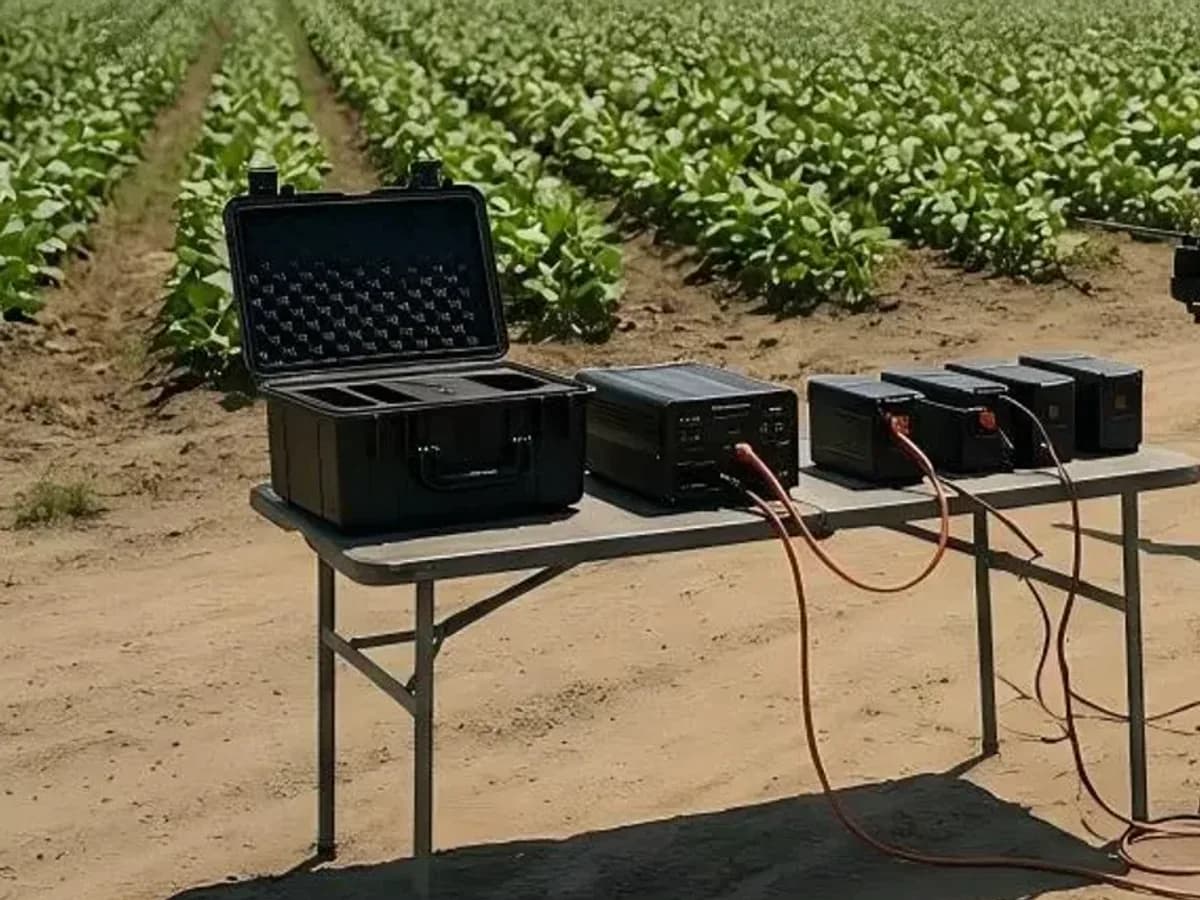
A storage battery is silent, needs no fuel in the field and can be recharged at the base overnight. It is limited by its capacity in kWh and by the inverter's output power. Besides drones, it can charge tricycles and power tools, lights and small pumps. A tricycle can carry it to where the work is.
Solar power
Solar output depends on the location, the season and the panel area. INPE's Brazilian Solar Energy Atlas shows high irradiation in most of the country, but it varies by region and time of year. In practice, solar works best at the base, refilling storage batteries and tricycles during the day; on its own it rarely covers the peak of fast drone chargers.
Tricycles charge at the base
Many electric tricycle models charge from a standard socket at the base, overnight (check the technical sheet), so they add energy to the day but rarely add to the peak in the field. Count their kWh in the daily total and plan the sockets and the parking space. In the other direction, a tricycle is a practical way to carry batteries, chargers, a storage battery and water between the base and the field, which shortens the trips that eat into flight time.
Compare the cost of each option
Put the options side by side for a typical week: purchase or rental, fuel, maintenance, the hours of work each one allows and the noise and handling it brings. A generator costs less to buy and more to run; a storage battery costs more up front and little to run; solar needs space and time. Use your own fuel prices and tariffs, and treat the result as an estimate to be confirmed in the first weeks of use.
Safe charging in the field
Charging outdoors adds heat, dust and fuel to the picture. Charge in the shade, on a stable surface and with ventilation; let batteries cool after a flight before charging them; keep cables and connectors dry and protected from vehicles; and keep fuel, products and charging in separate places. A fire extinguisher suitable for electronic equipment should stay within reach.
- Shade, stable surface and ventilation
- Cool batteries before charging
- Cables and connectors protected
- Fuel and products away from the charging point
Common combinations
Most operations end up combining two sources.
- Generator in the field plus a battery rotation
- Storage battery charged at the base overnight
- Solar at the base refilling batteries and tricycles
- Generator only for the busiest weeks
Where XT Brazil fits
XT Brazil supplies agricultural drones with their batteries and chargers by project, electric cargo tricycles from stock in Brazil, and can look into field storage batteries case by case through sourcing in China. The planner on the drones page estimates the batteries, charger ports and daily charging energy for your operation.
- Author
- XT Brazil Editorial Team
- Updated
- Oct 23, 2026
- Sources
- Related page
- How many drones and batteries to prepare