
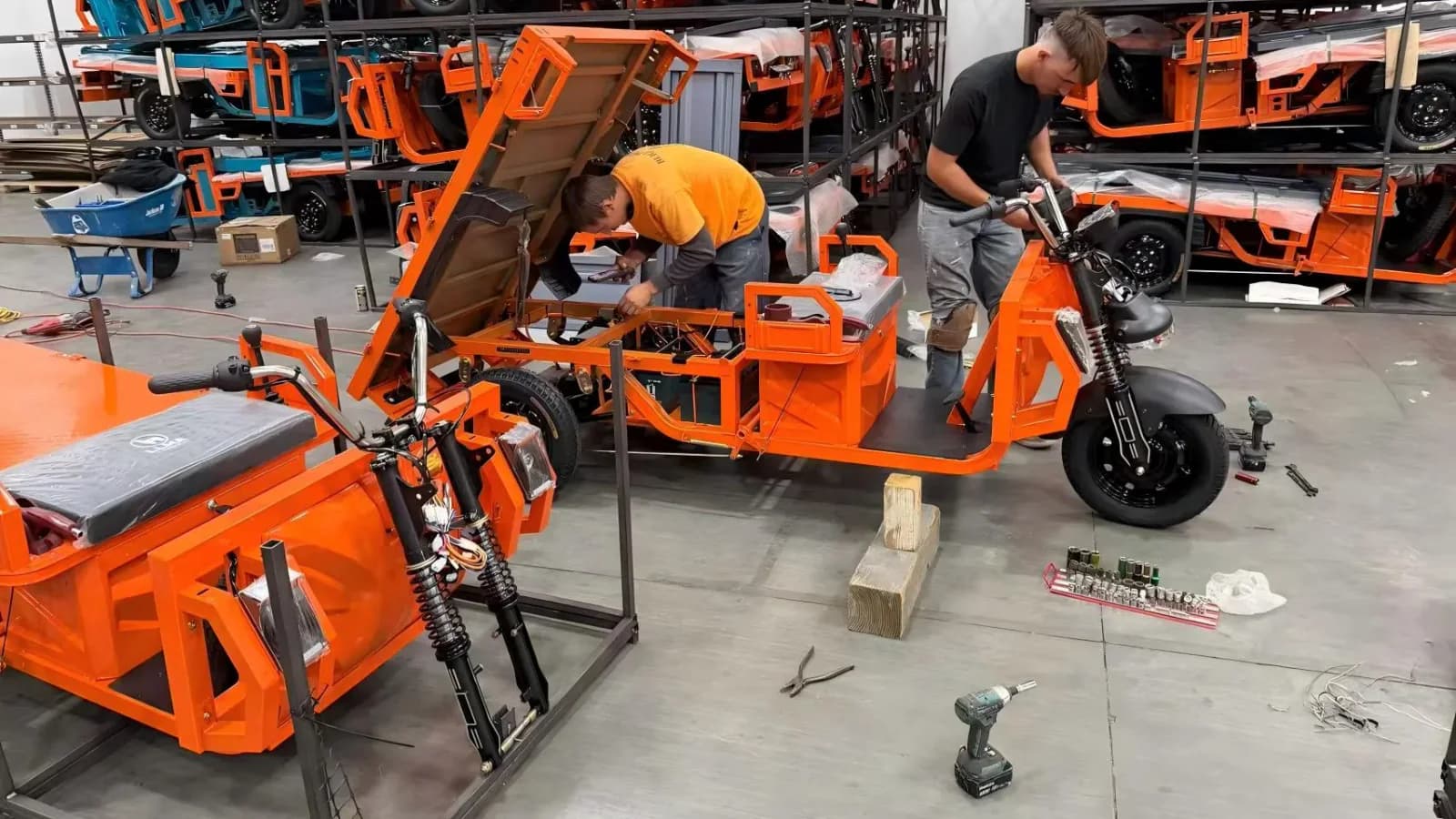
Who buys an electric cargo tricycle
The usual buyers share a routine of short, repeated trips: neighborhood shops that deliver, building-material depots, fruit and vegetable sellers, gated communities, factories moving parts between buildings, small farms and estates. For these businesses the numbers that matter are the daily running cost and how long the vehicle stands still when something goes wrong. Before choosing models, list who already buys from you and what kind of load they carry.
- Shops and neighborhood deliveries
- Depots, warehouses and industrial sites
- Small farms, estates and rural properties
- Gated communities and service companies
Start with a few versions
A small dealer does not need ten versions on the floor. Two or three well-chosen configurations, such as an open bed, a closed box and a tipping bed, cover most requests. What changes from one customer to the next is usually the body, the payload, the battery and whether the vehicle works on private ground or on public roads. Record those four points in every enquiry: over a few months they show which versions sell in your region.
The test drive is your main argument
Someone who has never used an electric vehicle wants to feel the pull with a load, the braking and the behaviour on a ramp. Keep a space for test drives, load the tricycle with a weight close to real use and let the customer drive. Explain charging as well: which socket it uses, how long it takes and where the vehicle will stay overnight. A good test drive answers more questions than any brochure.
Parts and after-sales before the first sale
Customers will ask what happens when a tire punctures, the battery loses range or the controller fails. Have an answer before you sell: a small stock of wear parts, a technical contact for diagnosis and a realistic lead time for parts that come from abroad. Record the serial number, model and delivery date of every unit; it speeds up any warranty case.
- Tires, inner tubes and brake parts
- Bulbs, wiring and connectors
- A spare charger for testing
- A record for every unit sold
Paperwork: each model has its own category
This is the point that raises the most questions. Under Contran Resolution 996/2023, how a small electric vehicle is classified depends on its power, maximum design speed and dimensions. An electric bicycle has two wheels and no throttle, so a cargo tricycle is never an electric bicycle. A self-propelled device (autopropelido) is limited to 1,000 W, 32 km/h, 70 cm of width and 130 cm between axles. Above those limits, a three-wheeler with an electric motor of up to 4 kW and up to 50 km/h is a ciclomotor; more powerful models are classified as tricycles (triciclos). Ciclomotores need registration, a plate and a rider with an ACC permit or a category A license. To register one, the Detran asks for the invoice, the Certificado de Adequação à Legislação de Trânsito (CAT) and the make/model/version code, and the manufacturer or importer must pre-register the vehicle in RENAVAM. Since 1 January 2026, an unregistered ciclomotor may not be driven on public roads. So a dealer should not promise that a model can be used on public roads: hand over the technical sheet and ask the buyer to confirm the category with the state Detran. Vehicles used only off road, such as inside a farm or a warehouse, are outside these rules; note that the Traffic Code treats the internal roads of condominiums and the parking areas of private establishments open to the public as roads, so they do not count as private ground.
- Ask for the technical sheet of every version
- Have the buyer confirm the category with the state Detran
- Do not promise use on public roads
- When the vehicle is for private ground only, write it in the proposal
Show the running cost, not only the price
The purchase price is the first question, but the decision usually comes from the running cost. Help the customer compare a day of work: kilometers driven, energy used and the electricity tariff on one side, fuel consumption and fuel price on the other. Use the customer's own numbers and present any figure as an estimate. Add what does not appear in the fuel bill: fewer moving parts to service, quiet operation and charging at the customer's own premises overnight.
- Daily distance and load from the customer
- Energy per 100 km and local electricity tariff
- Fuel consumption and price of the vehicle it replaces
- Results presented as estimates
Train the people who sell and deliver
Whoever sells the tricycle should be able to explain charging, battery care, load limits and what the warranty covers. Whoever delivers it should hand over the manual, show the controls and record the delivery with photos and the customer's signature. Those few minutes avoid most of the calls that follow a first sale.
Opening stock and replenishment
Start with a few units and track sales by version. With tricycles, replenishment runs at two speeds: units and parts. Units can come from stock in Brazil when the model is available, or from a planned import, which takes longer. Wear parts should always be on hand. Review stock after every sale: which version left, what the customer asked and which part was requested.
Where XT Brazil fits
XT Brazil has electric cargo tricycles in stock in Brazil, with test drives, orders from one unit and local after-sales, and it also offers OEM versions for volume orders (body, color, brand, battery), subject to the model and commercial confirmation. For dealers, the conversation starts with your customers, your region and the versions that make sense. Prices and terms are confirmed in writing.
- Author
- XT Brazil Editorial Team
- Updated
- Oct 23, 2026
- Sources
- Related page
- Electric cargo tricycles