
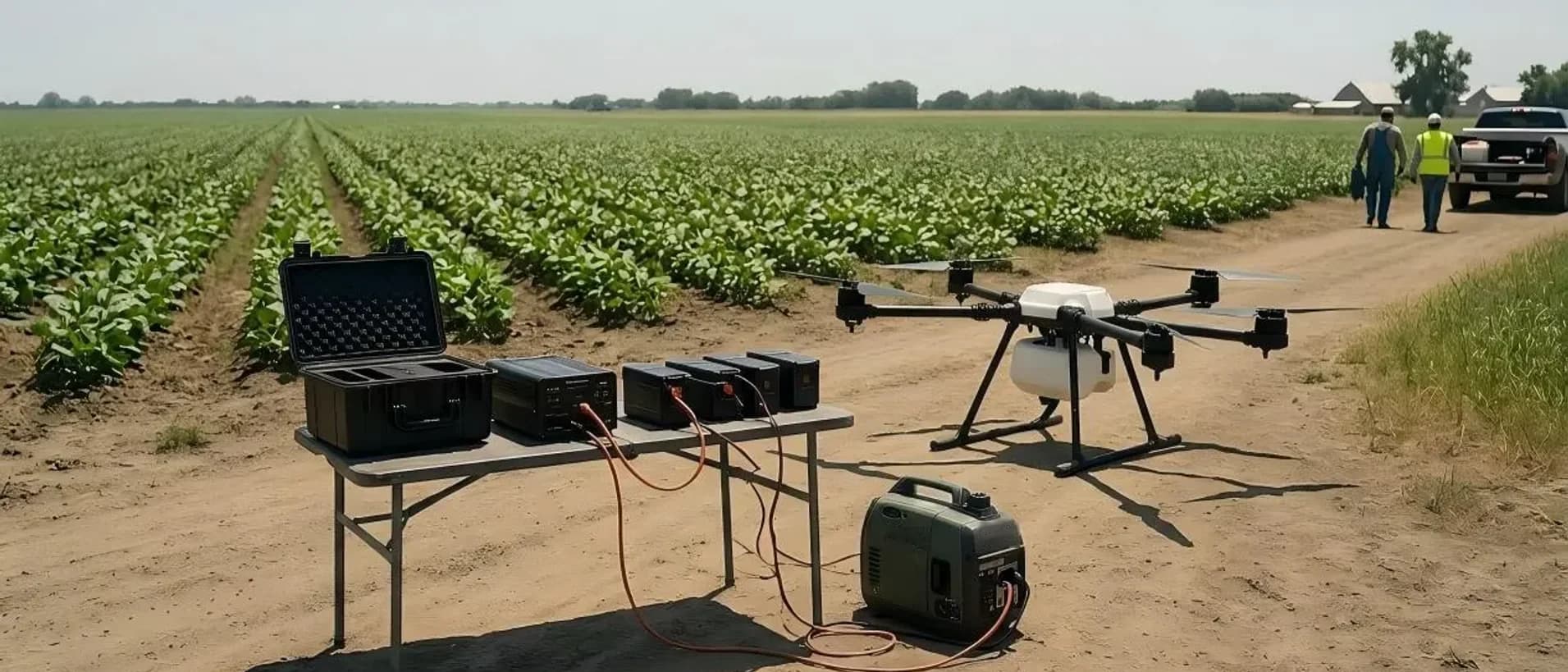
Begin with the operating day
A useful planning conversation starts with how many hours the team wants to fly, how far the field is from the charging point and how many drones share the same charging setup.
- Number of drones working at the same time
- Expected flights per drone per day
- Charging and cooling rhythm
- Distance between field, truck and charging point
Separate rotation batteries from backup batteries
Rotation batteries keep the daily work moving. Reserve batteries protect the team when a unit fails, ages or cannot be charged fast enough. Mixing the two creates confusion at the busiest time.
- Rotation batteries support the planned work.
- Reserve batteries cover an unexpected failure.
- Reserves cover the time a replacement takes to arrive.
A rule of thumb for the rotation
Each battery spends part of the cycle flying and the rest being swapped, cooled and recharged. Divide the whole cycle by the flight time and round up to get the batteries one drone needs in rotation; then add the reserves. Dividing by the flight time alone leaves a small margin, because the drone also spends a few minutes on the ground between flights.
- Batteries in rotation per drone ≈ (flight + swap + cooling + recharge time) ÷ flight time, rounded up.
- Total per drone = rotation batteries + reserve batteries.
- Example with made-up numbers: 10 min flight, 3 min swap and refill, 10 min cooling and 15 min recharge give 38 ÷ 10 = 3.8, so 4 batteries in rotation, plus reserves.
- Measure the times with your own drone, charger and generator; heat and charger power change them.
Count the chargers and the power too
Extra batteries do not help if they wait in line for a charger. In a steady rotation, the number of batteries charging at the same time is about the recharge time divided by the time between two flights. The chargers need that many charging outputs, and the generator or grid connection has to run all of them at once, with a margin.
- Batteries charging at once per drone ≈ recharge time ÷ (flight + swap time), rounded up.
- Example with the same made-up numbers: 15 min recharge ÷ (10 min flight + 3 min swap) = 1.2, so 2 batteries charging at once per drone.
- Generator power ≥ input power of each charger × chargers running at once, plus a margin; the input power is on the charger's label.
- Count the fuel or energy for the whole day, not only the peak.
Use the first order as a planning test
The first order should validate the usage assumptions: flights per day, charging time and how many batteries actually rotate. The planner on the drones page helps estimate those numbers before more batteries are ordered.
- Author
- XT Brazil Editorial Team
- Updated
- Oct 23, 2026
- Related page
- Agricultural drones and batteries